Mastering Tricky Passages: A Live Q&A on Practice Strategies
Every piece has them — those few bars that feel impossible no matter how slowly you practice. This Q&A-style stream is dedicated to the art of breaking through technical roadblocks, and we want to work on YOUR passages.
Submit the bars that have been giving you trouble as a reply to this thread — include a screenshot of the score, the bar numbers, and what specifically isn't working — and we'll tackle as many as we can live, with concrete strategies you can take straight to the practice room. The more specific your submission, the more targeted the help.
📩 How to submit: Reply below with (1) the piece and composer, (2) a screenshot of the score with the tricky passage clearly visible, (3) the bar numbers, (4) a short description of the problem (left hand? right hand? coordination? memory?), and (5) optionally, a short video or audio clip of you playing the passage. Submissions close 24 hours before the stream.
Join us live on May 29, 5pm CEST.
11 replies
-
Hi This is really timely livestream. I'm really looking forward to this. I'm having trouble with the PIMA arpeggios of the B section of HVL's Prelude No.4. My specific issue is playing this section with a good performance speed with accuracy and control with my RH. I know accuracy, coordination and control are more important than speed, but playing this passage at a slow tempo doesn't sound right to me.
I've been practising these arpeggios at variable tempos (including dotted rhythms), used sequential and full planting and no planting. However, at higher tempos, the arpeggios become uneven as my accuracy, control and coordination suffer.
The questions I'd like you to address are:
1. what are the best ways to practice these PIMA arpeggios?
2. While performing, what type of RH finger preparation should be used?
3. Are sequential and partial planting the same? I got a piece of advice from someone to use partial planting on this section (specifically to plant IMA together on the treble strings immediately after playing the bass with P). I was wondering if this will work and would like to know your opinion.
Apologies for the long text and too many questions,
Thanks in advance!
-
Lullaby by Isaias Savio - not very difficult, but there is very little repetition which is common in the beginner-level stuff I've been learning, and I feel challenged by this piece. I'm doing my best to memorize but neither my right not left hand seem to know where to go next.
Also the 9th and 10th measures of Op 50 No 13 (Allegro - Le Papillon) by Giuliani they are very repetitive and also very fast. I'm practicing slowly but can't seem to move up the speed. The issues, as far as I can tell, are the thumb playing the correct base note (right hand), and the left hand moving fast enough to fret the correct notes.
-
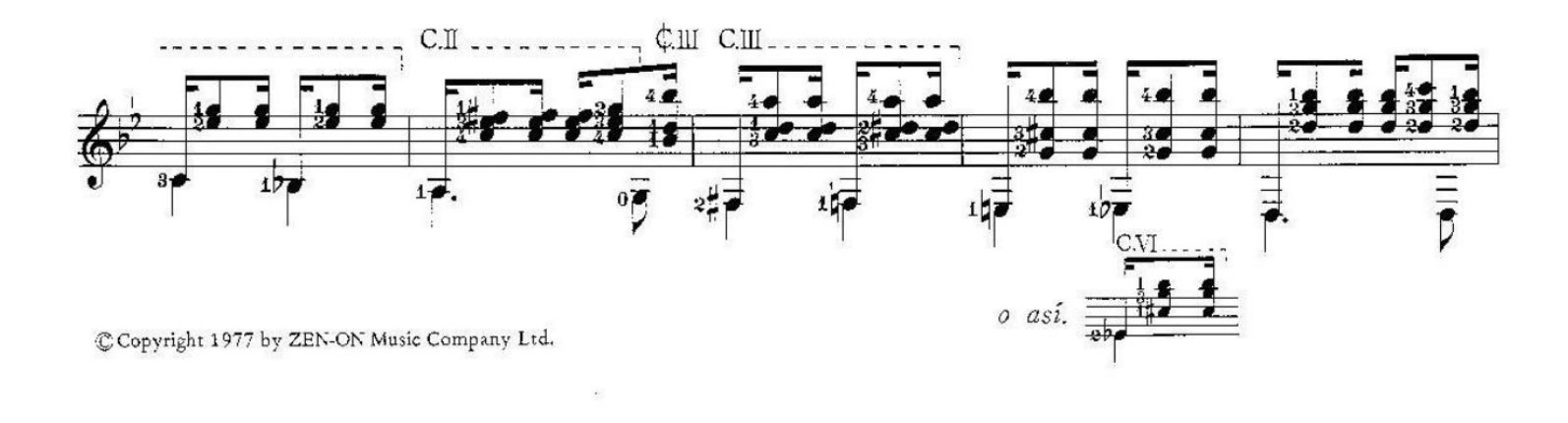
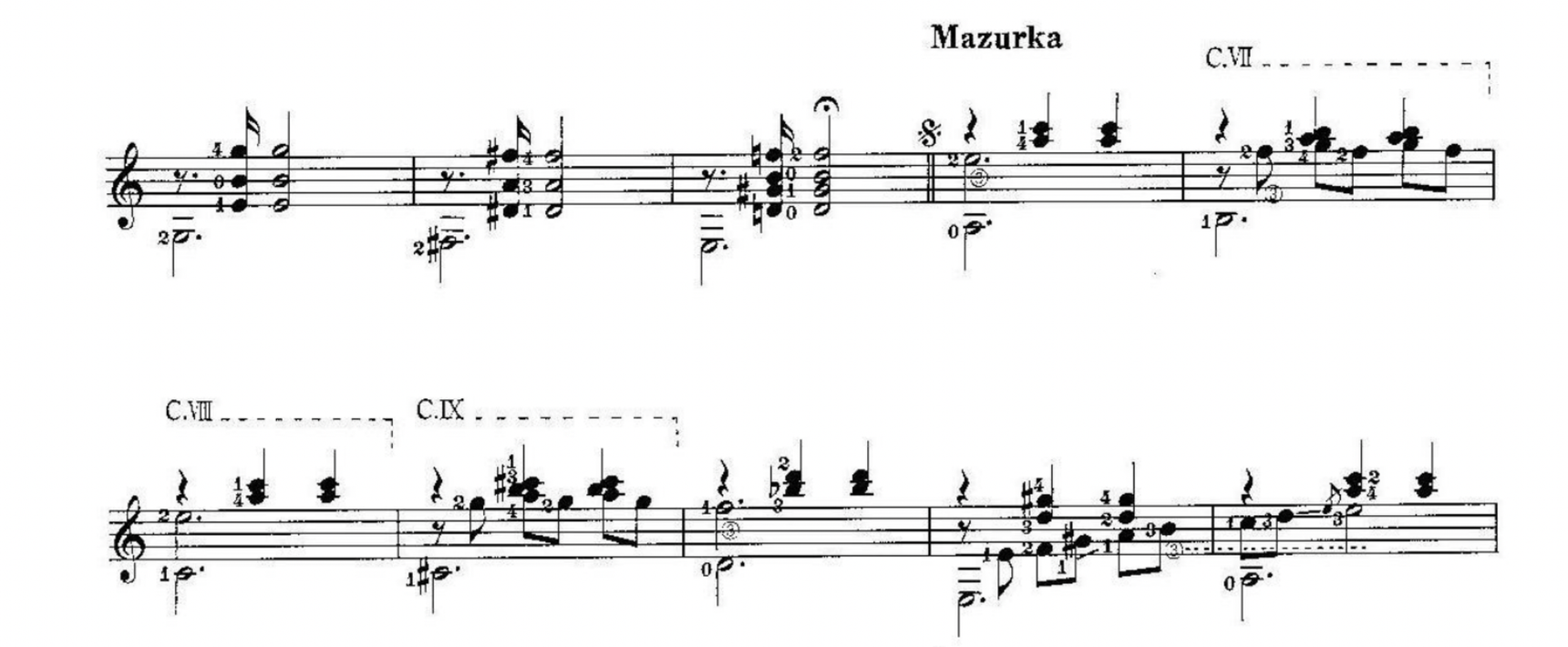
I have a general question for which I'll present two specific examples. The question is: at what point should one decide that a particular problem is insurmountable, and that either some kind of 'accommodation' should be found, or the piece should be abandoned altogether. My two examples come from the music Augustin Barrios, and both involve large left hand extensions. The first is taken from the beautiful 'Choro de Saudade'. In the second last bar of Example 1, we are required hold our second, third and fourth fingers in the fifth position, while the index reaches back to the second (and subsequently the first) fret. Personally, I can extend to the E natural, but not the E flat, at least not cleanly. (My index finger typically arrives on the fret, and the note winds up being completely muffled.) I have practiced this particular passage from time to time over a period of many years, and although I have gotten much closer to managing it over time, those last few millimetres just seem to be beyond my capacity for extension. (I have watched Mircea's video on left hand extension, and his ideas have certainly helped, but this particular chord remains a hurdle for me.) The second example is from one of Barrios's best known pieces, the 'Mazurka Apasionada'. The difficulty here occurs in the second and fourth measures of the section marked 'Mazurka' (Example 2). Here, the problem for me involves maintaining the barre firmly in place as the second third and fourth fingers reach forward. My first finger invariably gets pulled forwards (i.e. towards the sound hole) as well and the highest voice gets completely lost. Again, this is a passage I have tackled many times over the years with little success! So, to return to my general question: should I search for some simplification (for example, dropping a single note, which is possible in the Choro but not in the Mazurka, at least not without losing the intended dissonance) or should I simply admit that these pieces are not for me - after all, there are plenty of pieces that I could be learning without the headache!
Edit: I am aware of the possibility of playing the problem passage in the Choro de Saudade with the left hand lifted above the fingerboard (cello style, with the thumb fretting the bass notes) as discussed by the late Sabrina Vlaskalic in her ToneBase video. (It still upsets me to recall what terrible fate befell her.) I've never given this approach serious consideration, as it seems to be trading one problem for another of equal difficulty!
Example 1: Barrios, Choro de Saudade, mm 24-28
Example 2: Barrios, Mazurka Apasionada, mm 6-15
-
Not sure if this is too late - in Sons De Carrilhoes (tonebase edition) there are 2 scale passages that are a bit challenging. - Bar 12, 13, 14 and 15, and also Bar 29,30, 31 and 32. Deciding on fingering is tricky - there are 4 or 5 variations (at least) that can be used for these passages. Finding a fingering that feels natural and flows easily is tricky - I find a fingering that I like at a moderate speed is sometimes not so good at a faster speed.
-
Until about 1/2 way I thought I was watching live - I am getting old :)
I have a few questions about the Giuliani -
1)I play the pima section with alternating planting of P and IMA, and back when I could play the VL 4 I think did the same. Is this OK approach or does it miss something?2)Since I am on the comeback from 15 year break I have been playing the chords in the Giuliani with individual L hand finger preparation wherever possible instead of "grabing the chord" - Is this OK?
3)I think I remember playing the Sor chord study you mentioned. One of the Seqovia studies right? Can you share the OP and NO?
-
I looked that up during the livestream - it's number 20 of opus 31. (It's also included in that once famous volume of Sor studies selected by Segovia.)
-
Also had to watch the replay. My sister came over right when it started. Will be watching to see if your questions are answered.
Thank you for the Sor info. I didn't have a clue what Martin was referencing. Don't know what I don't know
- Thank you for addressing my concerns. I now have my favorite Martin Zimny quote: "The goal is not to practice it until you get it right but to practice it until you can't get it wrong anymore."